

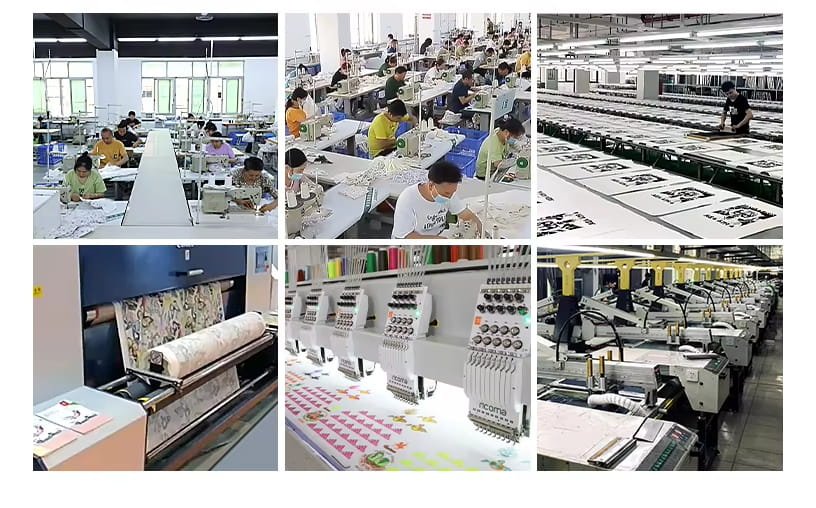
In the clothing industry, there is an unwritten consensus: 90% of the initial budget for establishing a new clothing factory is allocated to sewing machines.
Then, some people might wonder: Are not cutting machines, ironing equipment, and office facilities not important? The answer is that the sewing machine is the core that determines the “life and death” of the factory – it is not only a production tool but also the profit engine of the clothing factory. This seemingly “biased” investment conceals the underlying logic of industry survival and profitability.
一、Key to production capacity: Sewing machines determine the upper limit of order acceptance
The core competitiveness of the clothing factory lies primarily in “delivery speed”.
he needle speed of a household sewing machine is only a few hundred per minute, while industrial high-speed flat sewing machines can reach over 3,000 needles per minute. Take a pair of jeans as an example. The industrial machine production line can produce hundreds of pairs in a day, while the household machine can only complete a few pieces.
For factories that make profits through bulk orders, the absence of efficient industrial sewing machines means they cannot secure large orders or meet delivery deadlines, and eventually they will be eliminated from the market.
二、Quality Core: Sewing machines are the “gatekeepers” for the overall quality of the finished products
The quality of the clothing can be judged simply by its stitching.
The threads of high-quality industrial sewing machines are evenly and neatly arranged, ensuring stable garment shapes and preventing thread breaks. Special sewing machines such as seam lockers, button fastener machines, and computerized embroidery machines are crucial for achieving differentiated techniques like lace patchwork and three-dimensional embroidery.
In contrast, with cheap sewing machines, broken threads and broken stitches are common occurrences. This not only leads to a significant increase in rework rates but also wastes fabric and labor costs, ultimately damaging the brand’s reputation.
三、Long-term perspective: High-quality sewing equipment is the true “cost controller”
From the perspective of the long-term operation of the clothing factory, the sewing machine is not merely an expense item, but rather a core asset that helps to gradually reduce costs over the long term.
An industrial sewing machine with a stable reputation and mature performance can have a normal service life of 5 to 10 years. The equipment cost per piece of clothing is almost negligible.
On the contrary, equipment that is cheap but of poor quality often experiences frequent malfunctions within 1-2 years. It seems to have saved the initial investment, but in fact, it constantly incurs maintenance costs, labor expenses, and downtime. The hidden losses are far greater than the small budget saved initially.
It has long been a consensus in the industry: Cutting corners on key equipment often leads to higher costs in the end.
四、Transformation Pivot: Equipment Upgrades Determine Whether Factories Can Keep Up with Market Rhythms
As the clothing industry gradually shifts from a “mass production-driven” model to a “small batch, quick response, and multiple styles” model, the upgrading of sewing equipment has become a crucial driving force for factory transformation.
Intelligent sewing machines with features like automatic thread cutting, presser foot lifting, and programmed pattern sewing allow fast switching between styles and processes, making them ideal for customized and flexible orders. Their high efficiency also reduces dependence on skilled labor, helping factories maintain stable output despite labor shortages.
Take the cooperative factory of Greendimple as an example. By making advance arrangements for intelligent sewing equipment, it not only improved the delivery efficiency, but also established a significant advantage in the customization and small-batch order markets.
五、Budget Misconceptions: The incorrect sequence of investment often proves to be the culprit for losses in profits
Many clothing factories often fall into a common mistake when planning their finances:
Factories often invest heavily in office environments, storage space, or non-core equipment, while neglecting proper investment and maintenance of sewing machines—the true heart of production.
As a result, when orders arrive, poorly maintained or inadequate equipment breaks down frequently, increases rework rates, and causes repeated delivery delays. Ultimately, this damages customer trust and undermines long-term business relationships.
A more rational budgeting logic should be: prioritize ensuring the stability and production capacity of the core sewing equipment, and then gradually improve the auxiliary configurations based on actual business needs.
Conclusion: The sewing machine is not an expense; rather, it is an investment that determines the profit margin
The practice of “allocating the majority of production budget to sewing equipment” in the industry is not stubbornness, but rather a rational choice based on years of practical experience.
The level of equipment directly affects the scale of orders that the factory can handle, the quality rate of the finished garments, and the final profit margin.
For small and medium-sized clothing enterprises, carefully selecting equipment based on product categories and order structure—and prioritizing durability and after-sales support—ensures that every investment translates into real competitiveness.
Just as the principle that Greendimple has always adhered to: A stable manufacturing foundation is the fundamental support for the long-term growth of clothing brands.